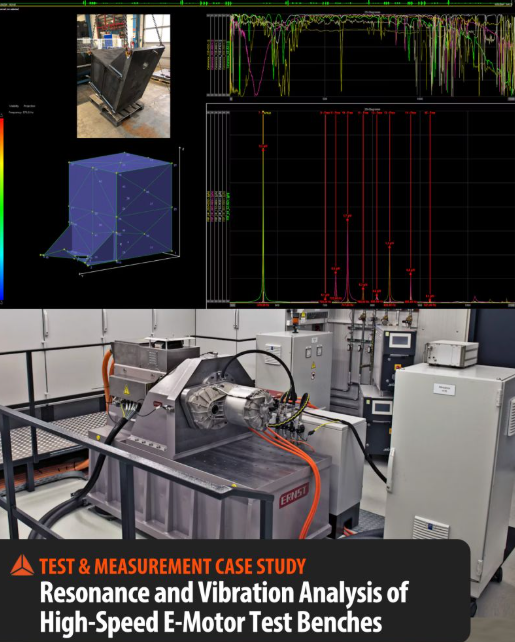
How can critical resonances in high-speed e-motor test benches be reliably identified?
Our joint case study with Dewesoft demonstrates how FEM simulations and real-world vibration measurements work together to validate the dynamic behavior of complex test bench systems.
In high-speed test benches operating at up to 20,000 rpm, high mechanical stiffness and controlled vibration behavior are essential for accurate measurement results. Particularly in modified test bench configurations, resonances may occur within the operating speed range.
As part of the case study, we combined FEM simulations with experimental modal analysis and vibration measurements. Using the Dewesoft SIRIUS X data acquisition system and DewesoftX analysis software, we identified critical natural frequencies and validated simulation results against real-world measurement data. During the validation of the base frame, deviations between FEM calculations and modal test results were below one percent.
The findings highlight why developing and modifying high-speed test benches requires an understanding of the entire mechanical system rather than individual components alone.
The full case study provides detailed insights into the methodology, measurement results, and technical validation. Find out more here.
Special thanks to Dewesoft and the Electrotechnical Institute at Karlsruhe Institute of Technology (KIT) for collaboration.